


Syllabus: GS3/Economy
Context
- Tourism has been one of the major driving forces behind India’s economic transformation.
About Tourism Sector in India
- Tourism in India is an important vehicle for economic growth, employment creation, regional development, cultural exchange and international engagement.
- It brings about wide-ranging multiplier effects and assumes a prominent position in India’s developmental journey and Viksit Bharat@2047 Vision.
Current Status
- India’s contribution to the economy through tourism stands at around US$ 231.6 billion and ranks among the world’s leading tourism economies (World Travel and Tourism Council).
- India witnessed 181.25 million International Arrivals and 93.35 million Foreign Tourist Arrivals (2014-2025).
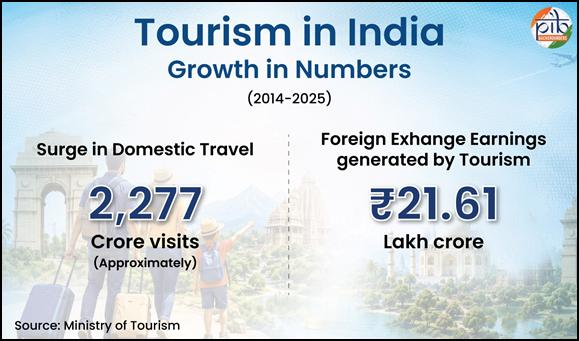
- India witnessed 20.6 million International Arrivals and thus improved its global ranking from 25th position in 2016 to 20th in 2024.
Importance of Tourism
- Economic Growth and Employment: Tourism leads to income generation, foreign exchange earning and employment in various industries such as hospitality, transport, handicrafts and food service industries.
- Example: Tourism in Goa leads to employment in hotels, taxis and restaurants in addition to providing livelihood to local artisans.
- Regional Development: Tourism has emerged as an important tool of balanced regional development. Government measures are aimed at:
- Developing the north-east region.
- Developing rural tourism.
- Development of Purvodaya vision for Eastern India.
- Culture and Heritage Promotion: Tourism helps in preserving and promoting the cultural traditions, monuments and heritage.
- Example: Tourism to Khajuraho Temples and Hampi has helped in preserving these structures.
- Building Soft Power: Tourism helps in building soft power and facilitates cultural diplomacy.
- Example: India’s G20 Presidency showcased India’s heritage and culture before the global audience.
- Community Empowerment and Inclusive Growth: It offers livelihood opportunities to local communities particularly women and rural communities.
- Example: Homestay tourism in Sikkim and Kerala is an example of livelihood generation for locals.
- Environmental Preservation through Sustainable Tourism: Through responsible tourism, it helps in conservation of biodiversity and natural ecosystems.
- Example: Ecotourism activities at Periyar Tiger Reserve (Kerala) help in conserving the area as well as offering livelihood opportunities to locals.
- Mamallapuram has become the first UNESCO World Heritage Site in South Asia to be bestowed with Green Destinations Silver Certification.
Key Related Initiatives
- Swadesh Darshan Scheme (2014): It is a Central Sector Scheme which envisages the development of Integrated and Theme Based Tourist Circuits in India.
- It gives financial assistance to State Governments and Central Authorities for developing world-class tourism infrastructure.
- Swadesh Darshan 1.0: More than 76 Projects costing in excess of ₹5,000 crore have been sanctioned in 15 different thematic circuits.
- Swadesh Darshan 2.0 (2022): It aims to develop sustainable and experiential tourism.
- Pilgrimage Rejuvenation and Spiritual, Heritage Augmentation Drive (PRASHAD) Scheme and Spiritual Tourism: It aims to improve the infrastructure at various pilgrimage centres.
- Various destinations like Somnath, Srisailam and Govardhan have benefitted through improved safety, sanitation and visitor amenities.
- Special Assistance to States for Capital Investment (SASCI) Scheme: It has been announced in Union Budget 2024-25 with an outlay of ₹3,295.76 crore.
- This scheme is being implemented by the Ministry of Finance.
- It provides long-term interest-free 50-year loans to the States to increase their capital investment, promote economic growth and incentives for reforms in various sectors like mining, urban infrastructure and road safety.
- Capacity Building for Service Providers Scheme: More than 4.5 lakh persons have been trained till 2025.
- Proposed in Union Budget 2026-27 is establishment of National Institute of Hospitality and upskilling of 10,000 tourist guides.
- Technology, Connectivity and Global Competitiveness: India has made significant progress in facilitating travels through expansion of e-Tourist Visa facility, various digital platforms such as NIDHI and NIDHI Plus for tourism players and digital promotion through Incredible India campaign.
- Improved connectivity through expansion of highways, modernization of railway stations, Vande Bharat trains, UDAN scheme and upgrading of airports and last-mile connectivity.
- Sustainability Initiatives: Development of niche tourism such as bird watching circuits, Himalayan trekking trails and turtle tourism to spread out the tourists’ inflows.
- Travel for LiFE initiative for encouraging environmentally responsible behavior amongst tourists and industry.
- Challenge Based Destination Development (CBDD) initiative in ecotourism and spiritual tourism.
Previous article
Supreme Court Sought Trauma Care System to Curb Road Deaths
Next article
India Needs to Drive the Robotics Revolution
